

It has always been interesting to me to know that Daisy Low founded the most important organization for girls in the United States, yet she herself was childless.* While most people may go off on all the psychological speculations they like, historians are happiest when we have evidence of emotional or psychological states in writing. Diaries, letters, and journals wherein a childless woman pours out her frustration or unhappiness about not having children gives historians like me a firmer footing. With those sorts of confessions, we can (depending on their strength and consistency) make suggestions or draw conclusions about what makes that particular diarist or letter writer feel a certain way.
Alas, Daisy left no such diaries or letters.
Well, that’s not exactly true. She did mention occasionally that she felt that she had failed in her duty to her family and to Willy’s family by not bearing children. She wrote, in an opaque sort of fashion, that she felt somehow less a woman than her two sisters by being childless. And certainly she lived in an era when the predominant role for women was mother.
But still I wonder: was there anything else that made Daisy Low so open to the idea of an organization for girls?
She was superstitious, as we know. She was also a devout Christian.
So, when I was in England poking around Daisy’s corner of the world, it struck me that every Sunday she sat in her local church, St. Peter’s. In the silence, surrounded by families, her thoughts would naturally gravitate to her desire to be a mother. Where would she turn? Inward, in prayer–and outward, to the physical church around her. And because Daisy was an artist, she could not have helped her eyes from straying to St. Peter’s gorgeous stained glass windows. When I took a count, the majority contained images of infants and children.

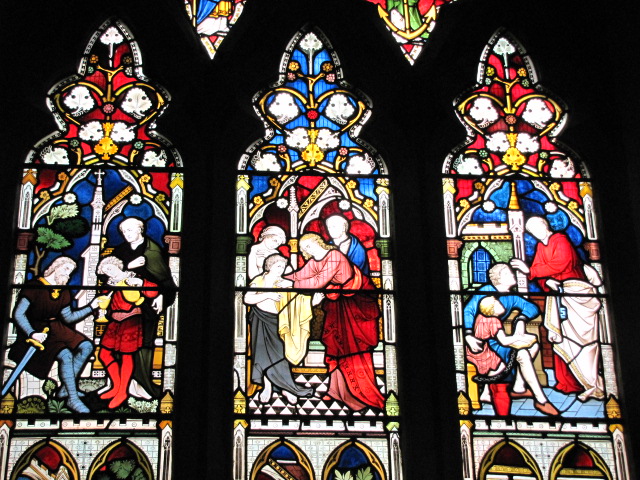

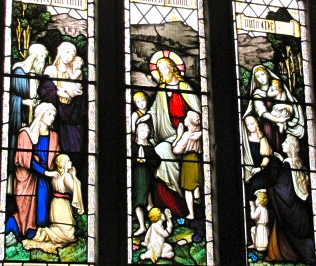

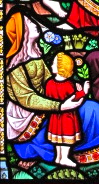 The years that Daisy lived in Wellesbourne and attended St. Peter’s Church were the years when she would have been thinking about why she was not pregnant. Did these idealized images of children–and of the adults instructing them, caring for them–sear themselves into her mind only to float to the surface of her consciousness later as she listened intently to (the then also childless) Robert Baden-Powell describe the joy he took in his Boy Scouts and Girl Guides? Did those stained glass images from her quiet, reflective times become part of the context she gave herself for becoming involved with Girl Guiding? We will never know, but I like to think so.
Reading your blog makes Juliette so much more of a real person to me. I never even wondered why she had no children before. I would imagine too that the windows would have some impact on her. Good thinking !
Karen–thanks so much for writing!
There is much more in my book about why she did not have children–but to a degree it is all speculation because we can't know what went on between husband and wife, nor between physician and patient. It is interesting to wonder, and I am always intrigued by how our surroundings influence us. The windows in that church really struck me because of the number and type of children. Thanks again–